
What is OCRia-nano-1?
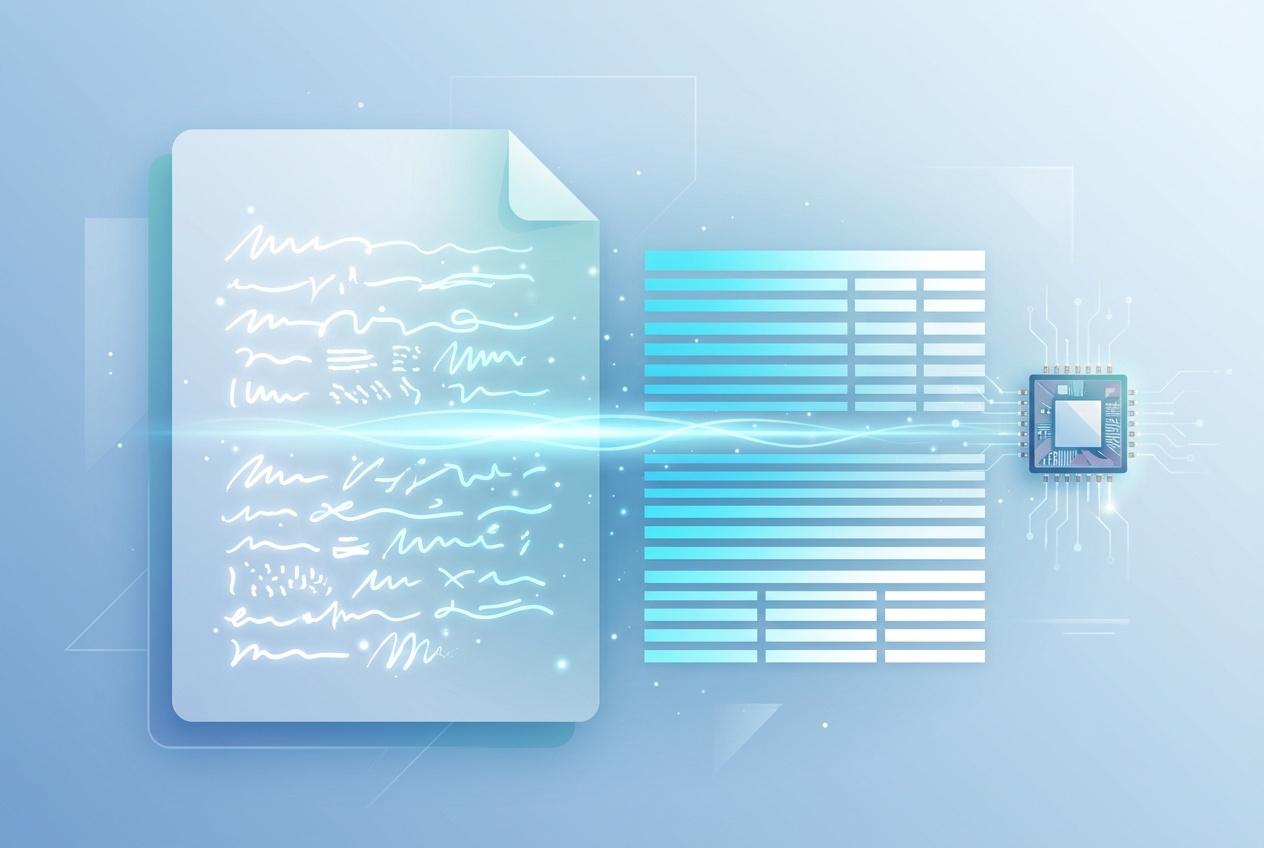
On November 23, 2026, LlamaIndex released the open weights for OCRia-nano-1. It is a lightweight document-parsing model set with 8.1 million parameters in total. It is built to run on ordinary CPUs, with no GPU needed.
It is not a standalone model with its own inference script. It is a set of models that run inside LiteParse, LlamaIndex’s open-source local document parser. LlamaIndex positions it as a fast first pass for large document collections, with larger vision-language models kept for the hardest pages.
What is inside
Per the Hugging Face model card, the 8.1M parameters are split across seven specialised models:
- Line detector finds text lines on the page.
- Script router picks the right recognizer for each line and detects upside-down lines.
- Four recognizers: Latin, CJK (Chinese, Japanese, Korean), right-to-left (Arabic, Hebrew), and a “world-script” model for about 17 more scripts.
- LayoutNet is a joint table and layout model. It finds tables (rows, columns, spanning header cells) and classifies layout blocks such as headings, lists, captions, and page headers and footers.
For digital PDFs, LiteParse reads the existing text layer directly. The OCR models only step in where text is missing or unreadable, such as scans and embedded images.
Speed and accuracy, as reported by LlamaIndex
These figures come from LlamaIndex’s own blog post and model card. They have not been independently tested.
| Metric | Reported result |
|---|---|
| Average time per page | 426 ms on a single CPU core (90% of pages under 862 ms) |
| Throughput | 27.8 pages per second with 16 single-core workers |
| Versus Tesseract in LiteParse | About 2x the throughput |
| ParseBench-2 score | 59.2 overall (59.5 on tables) |
| Comparison on ParseBench-2 | Indra 55.1, Marker 52.5, LiteParse with Tesseract 48.7 |
Treat these as vendor benchmarks. Results on your own documents may differ.
Best for
LlamaIndex recommends Nano for everyday documents where speed and scale matter:
- High-volume ingestion pipelines, such as indexing large RAG knowledge bases
- AI agents reading uploaded files
- Digital reports, straightforward contracts, and invoices with simple tables
- Routine scans and image-based pages
Limits to know
- LlamaIndex points to its larger OCRia-1 model for complex tables, handwriting, heavily degraded scans and scanned mathematical notation.
- Nano has no chart model, so charts stay as images. Chart-to-table extraction needs OCRia-1.
- The ParseBench-2 score of 59.2 is a relative leader among the CPU parsers listed, not a perfect score.
How to try it
Per the official blog and model card:
pip install liteparse
lit models pull ocria-nano
lit parse doc.pdf --format markdown- The model download is about 60–75 MB, including ONNX Runtime.
- Output is Markdown, JSON (with bounding boxes) or plain text.
- Inputs are PDFs, images and Office documents, which LiteParse converts.
- It runs on Linux, macOS and Windows through the CLI, Python and Node.js. WebAssembly is supported for browser and edge use.
- Pages render at 250 DPI by default (
--dpichanges it).
License
The model weights use a modified Open RAIL-M license, shipped with the download. LiteParse itself is Apache 2.0. For commercial use or anything beyond the standard license, LlamaIndex asks you to contact its team. Read the license before using it in a product.
FAQ
Do I need a GPU?
No. It is designed for CPU use.
Is it a complete OCR app on its own?
No. It is the set of model files that LiteParse runs.
Does it read multiple languages?
Yes. It covers Latin, CJK, right-to-left and other scripts, with automatic detection per line.
Is it free for commercial use?
Check the modified Open RAIL-M license first. LlamaIndex directs commercial or extended uses to its team.
Sources
Discover more from Juzhax Technology
Subscribe to get the latest posts sent to your email.